


| Issue |
J. Space Weather Space Clim.
Volume 16, 2026
|
|
|---|---|---|
| Article Number | 5 | |
| Number of page(s) | 15 | |
| DOI | https://doi.org/10.1051/swsc/2025057 | |
| Published online | 10 February 2026 | |
Supplementary material
Section 1. Hmin calculations. Access here
Section 2. Figures. |
Figure S1. Model calculated >70 MeV proton fluxes (gb function, |

 |
Figure S2. Model calculated >70 MeV proton fluxes (with gb function, |

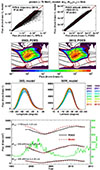 |
Figure S3: Model calculated >70 MeV proton fluxes (with gh function, |

 |
Figure S4. Model calculated >70 MeV proton fluxes (with gh function and Hmin(L, αm)=100 km, optimal collisional loss coefficients: a = 17.5, z1 = −50 km, z2 = 0.351, b= 1.142), and their comparisons with the observations by RPS-b (2013) and SEM2/POES (1998–2013). The figures are similar to Figures 6–9. |
 |
Figure S5. Proton flux observations (normalized to the equatorial flux intensity of the shell),y, as a function of B/B0 in four L shells. Discrete data points: based on observations within the L-shell interval by RPS-b in year 2013 (red: >192 MeV; green: >300 MeV); Solid line: gb function, computed with value of k indicated (see Equation (6); Vertical dashed line: |

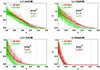 |
Figure S6. y, proton flux observations (normalized to the equatorial flux intensity of the shell), as a function of |


© X. Xu et al., Published by EDP Sciences 2026
Current usage metrics show cumulative count of Article Views (full-text article views including HTML views, PDF and ePub downloads, according to the available data) and Abstracts Views on Vision4Press platform.
Data correspond to usage on the plateform after 2015. The current usage metrics is available 48-96 hours after online publication and is updated daily on week days.
Initial download of the metrics may take a while.